Explore our blog for helpful articles about UV safety, weather updates, and healthy outdoor living. Stay informed and make every sunny day a safe one!

Popular articles
Unraveling America’s Most Devastating Storms
The deadliest hurricanes in US history tell stories not only of destruction and loss, but also of resilience, scientific advancement, and social change. From the Great Galveston Hurricane of 1900 to Hurricane Maria in 2017, these storms have rewritten meteorological records, reshaped entire cities, and forever altered the lives of millions. Understanding what are the deadliest hurricanes in US history offers insight into both the power of nature and the importance of preparation in the face of inevitable future storms.
1. The Great Galveston Hurricane of 1900 - The Deadliest in US History
No hurricane has ever claimed more lives in America than the Galveston Hurricane of 1900, which remains the deadliest hurricane in US history. Striking the Texas Gulf Coast on September 8, 1900, the storm reached estimated sustained winds of 140 mph-equivalent to a modern Category 4 hurricane. The island city of Galveston, sitting barely above sea level, was completely overwhelmed by a 15-foot storm surge.
- Death toll: Between 8,000 and 12,000 people
- Wind speed: 140 mph (Category 4)
- Damage: $30 million in 1900 (approximately $800 million today)
- Interesting fact: The storm destroyed nearly every home on the island, prompting Galveston to build a massive seawall afterward that still protects it today.
The Galveston disaster became a pivotal event in meteorological history, inspiring early versions of organized storm tracking and national weather warnings. It remains at the top of every list of deadliest hurricanes in US history.
2. The 1928 Okeechobee Hurricane - A Deadly Flooding Catastrophe
Second only to Galveston, the Okeechobee Hurricane of 1928 struck Puerto Rico first before tearing through South Florida. The storm made landfall near Palm Beach on September 16 as a Category 4 system, but its most catastrophic impact came inland. When hurricane rains caused Lake Okeechobee’s levees to break, a wall of water swept across the surrounding farmland communities.
- Death toll: 2,500–3,000 people
- Wind speed: 145 mph
- Damage: $100 million (equivalent to over $1.5 billion today)
- Notable fact: Over half of the victims were Black farmworkers living in low-lying areas with limited access to evacuation or information.
The Okeechobee disaster ranks among the most deadliest hurricanes in US history and prompted the eventual construction of the modern Herbert Hoover Dike around the lake.
3. Hurricane Katrina (2005) - A Modern-Day Tragedy
Among the deadliest hurricanes in recent US history, Hurricane Katrina stands as a grim reminder of nature’s fury meeting human failure. On August 29, 2005, Katrina hit the Gulf Coast as a Category 3 hurricane with sustained winds of 125 mph and an unprecedented storm surge of up to 28 feet in some areas. When the levees failed, 80% of New Orleans was submerged.
- Death toll: 1,833 people
- Damage: Over $161 billion, the costliest natural disaster in US history
- Wind speed: 125 mph
- Storm surge: Up to 28 feet in Mississippi
- Affected areas: Louisiana, Mississippi, Alabama, Florida
Katrina’s aftermath exposed major gaps in emergency management, social equity, and infrastructure resilience. It remains one of the deadliest hurricanes in US history since 2000 and continues to shape federal disaster response systems today.
4. The 1893 Sea Islands Hurricane - A Forgotten Disaster
The Sea Islands Hurricane of 1893, one of the deadliest hurricanes in US history, devastated coastal regions of Georgia and South Carolina. Making landfall near Savannah on August 27, it produced a storm surge over 16 feet that obliterated low-lying communities.
- Death toll: 1,000–2,000
- Damage: $10 million (nearly $350 million today)
- Interesting fact: Many of the victims were from Gullah communities—freed slaves who lived on the barrier islands. Relief efforts, led by the Red Cross, were among the first large-scale hurricane responses in US history.
This hurricane, though often forgotten, remains essential in any list of deadliest hurricanes in US history because of its social and historical significance.
5. The 1935 Labor Day Hurricane - Small but Catastrophic
On September 2, 1935, the Labor Day Hurricane became the first Category 5 storm to strike the US mainland. Hitting the Florida Keys with sustained winds of 185 mph, it flattened nearly every structure in its path.
- Death toll: 423
- Wind speed: 185 mph (Category 5)
- Pressure: 892 mb - one of the lowest ever recorded in the Western Hemisphere
- Notable fact: Many of the victims were World War I veterans working on a highway construction project; they were living in poorly built camps that couldn’t withstand the storm.
This storm remains one of the deadliest hurricanes in US history and the most intense hurricane to ever make landfall in the continental United States.
6. Hurricane Maria (2017) - A Humanitarian Crisis
When examining the deadliest hurricanes in US history since 2000, Hurricane Maria stands out as one of the most devastating. Making landfall in Puerto Rico as a high-end Category 4 storm on September 20, 2017, Maria destroyed the island’s electrical grid and caused a long-term humanitarian crisis.
- Death toll: 2,975 (revised estimate by George Washington University study)
- Damage: $90 billion
- Wind speed: 155 mph
- Power outage: The longest blackout in US history - 3.4 million people affected
Maria’s impact continues to influence disaster policy, energy infrastructure, and debates about the federal response to US territories. It remains one of the deadliest hurricanes in recent US history.
7. Hurricane Harvey (2017) - Record-Breaking Rainfall
While not the deadliest, Hurricane Harvey deserves mention among the deadliest hurricanes in US history since 2000 because of its immense rainfall and economic toll. Harvey made landfall in Texas as a Category 4 storm but lingered for days, dumping over 60 inches of rain - the heaviest rainfall ever recorded from a single storm in US history.
- Death toll: 107
- Damage: $125 billion
- Rainfall: Over 60 inches in parts of Houston
Harvey’s flooding displaced hundreds of thousands of people and demonstrated how rainfall, not just wind speed, can make hurricanes deadly.
Global Comparison: The Worst Hurricane in History
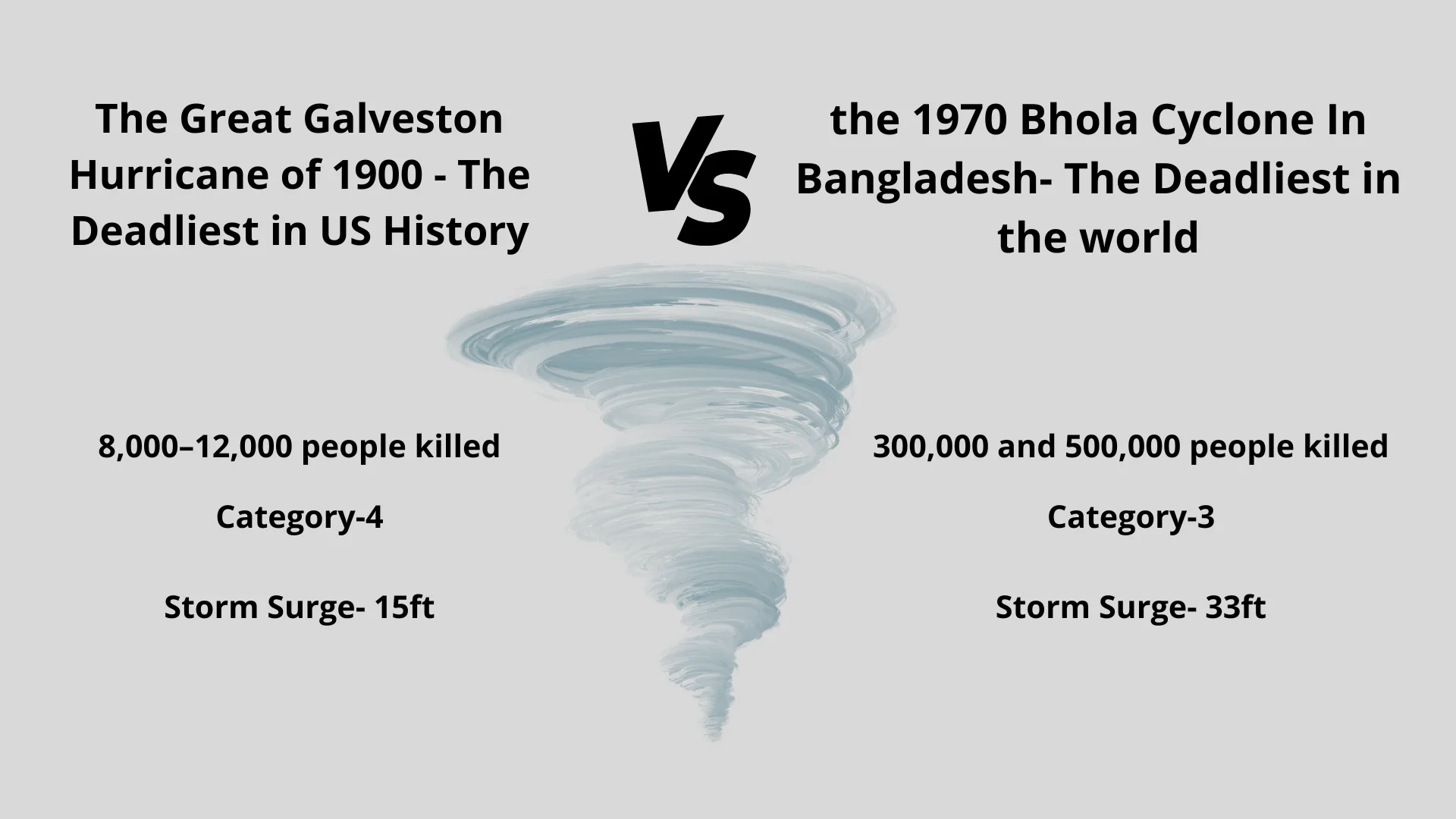
When discussing what is the worst hurricane in history(anchor), the 1970 Bhola Cyclone in present-day Bangladesh far surpasses even the deadliest hurricanes in US history. While the Galveston Hurricane of 1900 killed an estimated 8,000–12,000 people, the Bhola Cyclone claimed between 300,000 and 500,000 lives, making it the most catastrophic tropical storm ever recorded. With winds of about 115 mph and a storm surge reaching up to 33 feet, it devastated entire coastal regions and reshaped the political and humanitarian landscape of South Asia.
Learning from the Past: Patterns of the Deadliest Hurricanes in US History
What connects all the deadliest hurricanes in US history? Several key patterns emerge:
- Storm Surge and Flooding: Over 90% of hurricane-related deaths are due to drowning, not wind.
- Population Growth in Coastal Areas: More than 40% of Americans now live in coastal counties, increasing risk exposure.
- Socioeconomic Factors: Poorer and marginalized communities often suffer the most, with limited access to evacuation routes, sturdy housing, or insurance.
- Climate Change: Warmer ocean waters intensify storms, increasing the likelihood of future “megastorms.”
From Galveston in 1900 to Maria in 2017, the deadliest hurricanes in US history have tested the nation’s strength and compassion. Each tragedy has driven progress-from better forecasting to stronger infrastructure and improved disaster relief systems.
The question “Which hurricane was the deadliest in US history?” will always point to Galveston. But the broader story of the deadliest hurricanes in US history is one of learning, adaptation, and respect for nature’s unparalleled force. As climate trends shift and coastal populations grow, remembering the most deadliest hurricanes in US history remains essential-not as a record of destruction, but as a call to prepare, protect, and persevere.